Marcelo Mayer Is Gone. Did The Red Sox Just Make A Mistake?
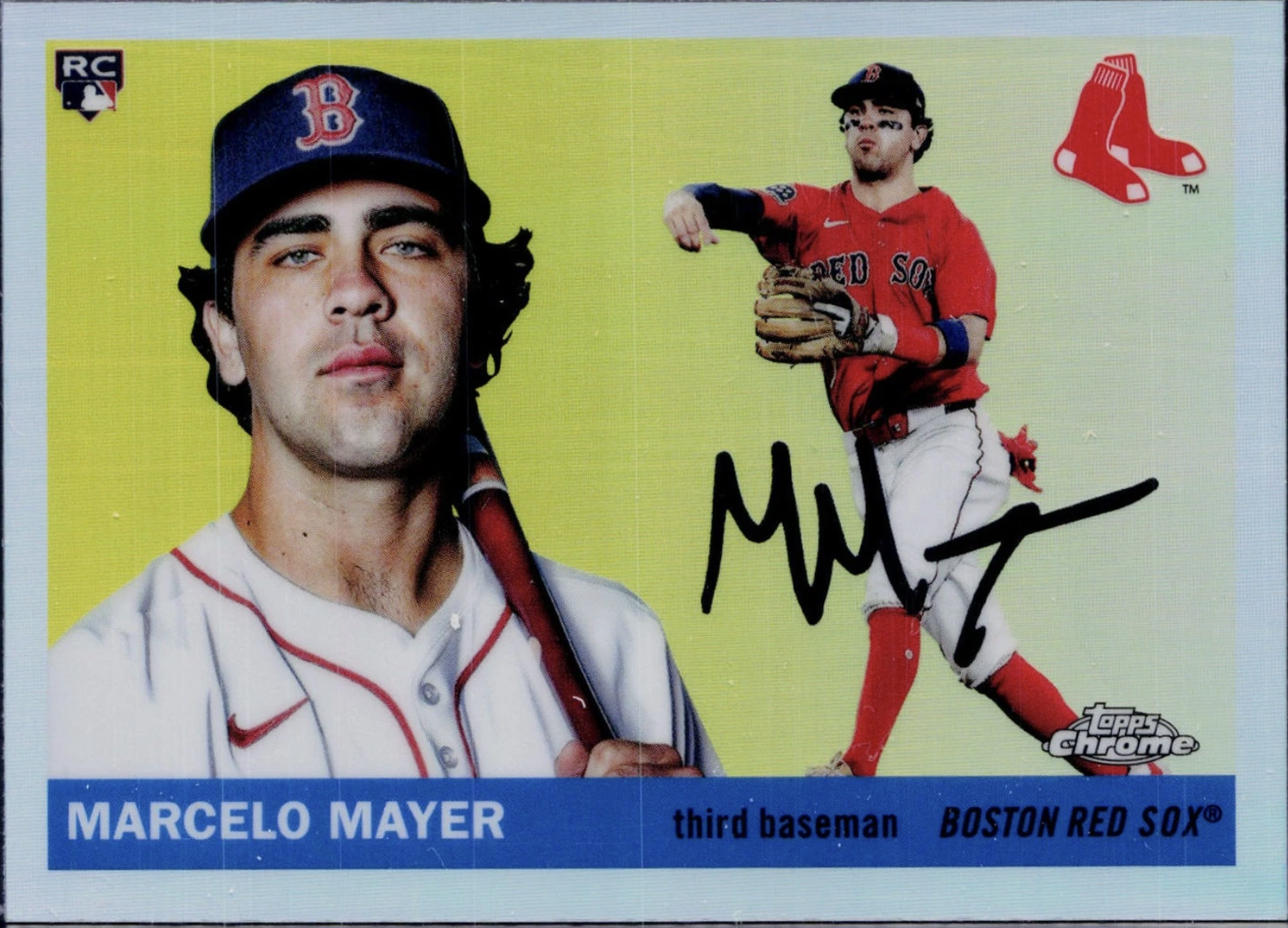
Five years after the Red Sox took Marcelo Mayer fourth overall in the MLB Draft— a pick some boards had rated as the best player in the class — his time in the organization ended with a trade day whimper.
The trade? San Francisco gets Mayer. Boston gets lefty reliever Erik Miller and a Single-A outfield prospect. That’s it. That’s the return on what was, for a few years, the most hyped position player prospect this farm system had produced in a generation. Referred to as a ‘scouts dream’ and the next Christian Yelich, Mayer is now a forgotten part of what could have been.
The instinct might be to call it a salary dump without the salary — a “we’re out of patience” trade. Whether that instinct is right depends on which version of Marcelo Mayer you believe is closer to the truth: the one scouts drew up in 2021, or the one who couldn’t stay on the field or hit a breaking ball long enough to prove it wrong.
Needs to tighten up his approach, as he chases at a high rate. Needs to improve pitch recognition, especially against breaking balls. Some questions about how his contact skills will translate against more advanced pitching. Seems to struggle to pick the ball up against left-handed pitchers and has had considerable platoon splits throughout his career – Sox Propsects
Who Mayer Was Supposed To Be
Coming out of Eastlake High in Chula Vista, California, Mayer wasn’t just a first-round prospect — some evaluators had him as the best prospect in the entire class, full stop, and he still fell to Boston at four.
Over the Monster’s pre-draft scouting report called his offensive game “a complete one” built around a smooth, all-fields left-handed swing. Prospects Worldwide’s draft profile went even further, framing him as “a clear impact performer on both sides of the ball” with a chance to eventually tap into 20-plus-homer power on top of a plus hit tool. National outlets threw around comps like Corey Seager and Brandon Crawford. He debuted on top-100 boards inside the top 20 and climbed as high as the top 10 within two years.
And defensively, Mayer was supposed to be just as as good at shortstop. From Over The Monster:
And the hype is not unfounded, as it’s hard to imagine a more well-rounded scouting report than what we’re seeing from the talented infielder. He appears to be a true all-around player, showing an ability to stick up the middle at shortstop. In fact, in Baseball America’s scouting report above they call him the best defensive shortstop in the class. By all accounts, he has everything you’re looking for defensively, with good instincts, great athleticism, and an arm that will play on the left side of the infield.
For a while, the scouts seemed to be right. He was the face of a farm system rebuild, grouped with Roman Anthony and Kristian Campbell as Boston’s “Big Three” — the trio meant to be the next homegrown core, the anti-Mookie-trade answer, proof the player development pipeline actually worked again.
Where It Came Apart
The read on Mayer was never really about bat speed or hands. It was two things, and both of them are visible with the benefit of hindsight in the same scouting reports that made everyone excited about him in the first place.
First, a tendency to chase and get exploited by breaking balls, and a body that simply wouldn’t stay on the field. He never played a full, healthy minor-league season after 2022. When he finally reached the majors in May 2025, he lasted 44 games before a wrist injury required surgery.
The Boston Globe’s Alex Speier laid out just how thin the health track record really was, noting Mayer had “never played more than 91 games in a season” at any level since 2022, en route to a .223/.278/.346 line across parts of two big-league seasons.
This year, he moved off shortstop to make room for Boston’s infield glut, and was hitting for a low average with modest power, and then a bone stress reaction in his left forearm — an injury he’d apparently been playing through for weeks — ended his season in late June.
The larger organizational context mattered as much as any single injury. Boston had already added Caleb Durbin over the winter, pushing Mayer off shortstop. Alex Bregman occupied third. And 20-year-old Franklin Arias, a more electric all-around talent, had rocketed up the system to become the new consensus top prospect — the shortstop of the future that Mayer was supposed to be. There wasn’t a clean everyday role left for him in Boston even before health became the tiebreaker.
Was It A Smart Trade?
As pure value, it’s a light return. A former top-10 prospect in baseball, even a diminished one, going for a middle reliever and a No. 14-ranked farm outfielder reads as a change-of-scenery salvage move, not a headline trade.
If you believe in buying low on former blue-chippers — betting that a 23-year-old with a clean left-handed swing figures it out somewhere with lower expectations and a clean slate — the Giants may have gotten a discount on a player who’s still four years younger than most of the league.
As roster construction, it’s defensible, maybe even necessary. Boston didn’t have anywhere to actually play Mayer, and had just spent the same trade deadline day adding Adley Rutschman and pursuing infield and shortstop upgrades.
Erik Miller is a real, controllable, hard-throwing lefty reliever added to a bullpen that was already performing near the top of the league. Craig Breslow made the fit argument himself when he addressed the trade, taking care to frame it as circumstance rather than a verdict on the player:
“In no way is this trade an indictment of Marcelo,” Breslow said, adding that pulling it off was “probably a credit to the player development group”.
Whatever you make of the framing, the baseball logic underneath it is real: for a team that spent three months of 2026 looking finished and is now pushing for a playoff spot, a proven big-league reliever with multiple years of control is worth more in real time than a fifth outfielder or a rebuild-timeline shortstop who might have needed another 18 months.
The honest answer is that this wasn’t a baseball-value trade so much as a fit trade. Boston converted a player who no longer had a role into a player who immediately does. That’s not always the same thing as winning the trade — but it’s not automatically losing it, either.
What’s Next For Mayer
The landing spot matters. San Francisco gives Mayer a path to everyday at-bats that Boston’s infield logjam didn’t, and it puts him back alongside Rafael Devers, who made the same one-way trip out of Boston last summer under very different but similarly unceremonious circumstances.
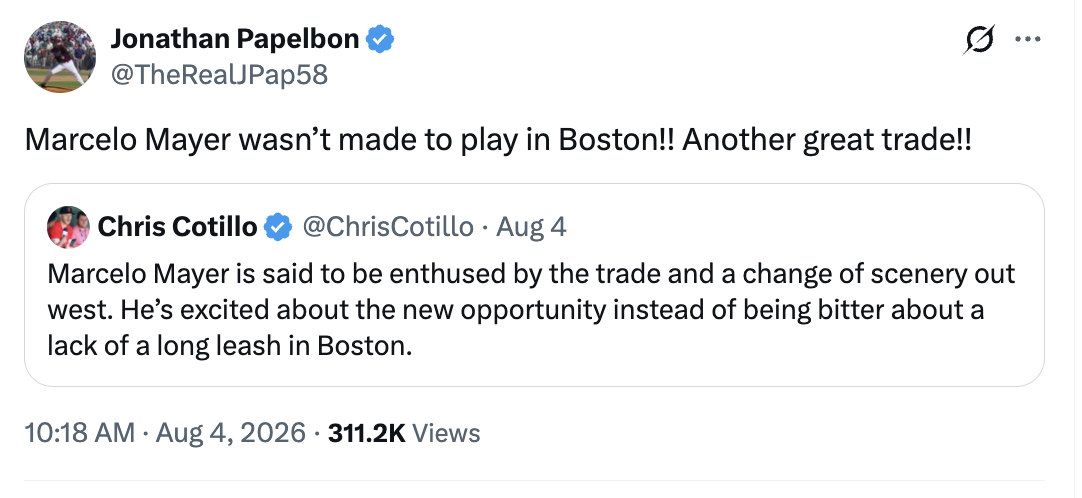
MassLive’s Chris Cotillo, who broke the news of how Mayer was taking the move, reported that Mayer was “enthused by the trade and a change of scenery out west” and excited about the new opportunity rather than bitter about his time in Boston.
Mayer said much the same himself once he got to the Bay Area, telling MLB.com, “It’s been a smooth transition. The guys have welcomed me with open arms”.
Not everyone in the Red Sox orbit received that news warmly. Former closer Jonathan Papelbon reacted to the Cotillo report with characteristic bluntness on X: “Marcelo Mayer wasn’t made to play in Boston!! Another great trade!!” (via NESN) — the kind of line that draws blood precisely because it’s aimed at a 23-year-old, not a proven veteran, and a reminder of how quickly the goodwill of a No. 4 overall pick can evaporate once health and production stall out at the same time.
Mayer is still working back from the forearm injury, with a rehab assignment at Triple-A Sacramento and a target of debuting for the Giants on their upcoming road trip — one that happens to end with three games at Fenway from August 21–23.
That series will be the real test, not the trade call itself: what Mayer looks like wearing an unfamiliar uniform at the ballpark where he was supposed to be a fixture for a decade. The bat speed and the swing were never the question. Whether the rest of it — the health, the pitch recognition, the polish — ever catches up was the question the whole time, and Boston simply ran out of patience to keep waiting for the answer. San Francisco just bought the rest of that experiment at a discount.